
Luxury Fashion Market to Reach USD 389.57 Billion at 4% CAGR by 2032: Market Size Share Forecast & Competitive Analysis
Luxury Fashion Market
Digital luxury, influencer marketing, and premiumization drive global luxury fashion market growth through omnichannel retail and sustainability.
“Maximize Market Research reveals that digital luxury and social influence are no longer trends, they are transforming how global consumers discover, engage with, and purchase luxury fashion.”
”
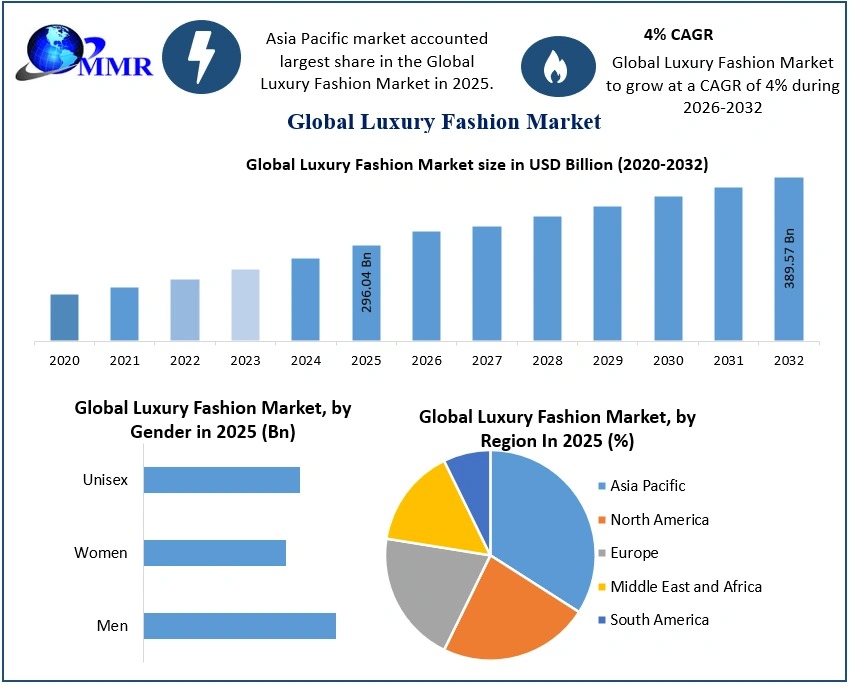
NEW YORK, NY, UNITED STATES, January 23, 2026 /EINPresswire.com/ -- Luxury Fashion Market was valued at USD 296.04 Billion in 2025, and the market size is projected to grow at a CAGR of 4% from 2025 to 2032, reaching an estimated revenue of nearly USD 389.57 Billion by 2032. — Maximize Market Research
Global Luxury Fashion Market Overview: Market Size, Growth Trends, Competitive Landscape, and Forecast Opportunities
Global luxury fashion market is witnessing steady expansion, driven by rising digital luxury adoption, social media influence, and premiumization trends. Increasing demand for high-end apparel, accessories, and beauty products, along with expanding e-commerce and omnichannel retail strategies, is accelerating luxury fashion market growth and market size expansion. Emerging economies, luxury-tech collaborations are reshaping the luxury fashion industry outlook, creating strong opportunities for brands and investors during the forecast period.
Get Full PDF Sample Copy of Report: (Including Full TOC, List of Tables & Figures, Chart) @
https://www.maximizemarketresearch.com/request-sample/126250/
What’s Fueling the Luxury Fashion Boom? Key Market Growth Drivers
Global Luxury Fashion Market is driven by social media promotions and celebrity endorsements that strongly influence consumer buying behavior. Influencers and celebrities enhance brand visibility, desirability, and engagement, especially among millennials and Gen Z. Digital marketing and social platforms are accelerating demand for premium apparel, footwear, and accessories, driving market growth.
Why High Prices and Fast Fashion Are Slowing Luxury Fashion Market Expansion
Global luxury fashion market growth is restrained by high product prices, limiting adoption among price-sensitive consumers. Premium materials, skilled craftsmanship, and advanced manufacturing increase costs, reducing repeat purchases and accessibility. Rising demand for affordable fast fashion further impacts the luxury fashion customer base, constraining market expansion during the forecast period.
Digital Luxury and Emerging Markets Unlock New Growth Opportunities
Global luxury fashion industry outlook presents strong opportunities driven by digital luxury platforms, influencer marketing, and expanding e-commerce channels. Growing disposable incomes and rising luxury consumption in emerging economies are creating new growth avenues. Omnichannel retail strategies and personalized marketing are expected to accelerate luxury fashion market size and long-term industry growth.
Luxury Fashion Market Segmentation: Product, Gender, and Distribution Channel Insights
Global luxury fashion market segmentation is classified by product type, gender, and distribution channel, providing detailed insights into luxury fashion market size and growth trends. Luxury apparel, footwear, accessories, watches & jewellery, beauty & fragrances, and eyewear dominate due to premium branding, high margins, and strong consumer demand for status-driven products. Women’s segment leads driven by higher spending frequency, while men and unisex segments are gaining traction. E-commerce, brick-and-mortar boutiques, resale platforms, and duty-free retail dominate due to digital luxury adoption, global reach, and experiential shopping, shaping the luxury fashion industry outlook.
Global Luxury Fashion Market Segments Covered :
By Product Type
Apparel Footwear
Accessories
Watches & Jewelry
Beauty & Fragrances
Eyewear
By Gender
Men
Women
Unisex
By Application
Brick-and-Mortar Boutiques
E-commerce & Online Luxury Retailers
Resale & Pre-Owned Luxury Market
Duty-Free & Travel Retail
By Region
North America (United States, Canada and Mexico)
Europe (UK, France, Germany, Italy, Spain, Sweden, Austria, Turkey, Russia and Rest of Europe)
Asia Pacific (China, India, Japan, South Korea, Australia, ASEAN (Indonesia, Malaysia, Myanmar, Philippines, Singapore, Thailand, Viet Nam etc.) and Rest of APAC)
Middle East and Africa (South Africa, GCC, Egypt, Nigeria and Rest of ME&A)
South America (Brazil, Argentina, Colombia and Rest of South America)
Download PDF Brochure @ https://www.maximizemarketresearch.com/request-sample/126250/
Europe and Asia-Pacific Lead Global Luxury Fashion Market Growth: Regional Outlook and Forecast Analysis
Europe luxury fashion market continues to dominate global revenue share, supported by strong brand heritage, tourism-driven luxury consumption, and high brand awareness among consumers. Tax-free retail policies and luxury shopping tourism across France, Italy, and the UK are driving demand. Despite economic uncertainties, rising premiumization trends and strong retail infrastructure are sustaining luxury fashion market.
Asia-Pacific luxury fashion market is expected to witness significant growth during the forecast period, driven by rising high-net-worth individuals, increasing billionaire population, and expanding middle-class purchasing power. Rapid urbanization, growing digital luxury consumption, and strong demand from China, India, and Southeast Asia are boosting market expansion. The region is emerging as a key growth engine for the global luxury fashion market.
Luxury Fashion Market Key Trends: Digital Luxury Adoption, Social Media Influence & Sustainable Fashion Driving Growth
Digital Luxury and E-commerce Expansion Driving Market Growth: The luxury fashion market is witnessing rapid digital transformation, with e-commerce platforms expanding global brand accessibility. Online luxury retail is gaining traction among millennials and Gen Z, driving luxury fashion market growth, market size expansion, and digital luxury adoption trends.
Social Media Influence and Brand Storytelling Shaping Consumer Demand: Social media platforms and digital marketing strategies are transforming luxury brand perception and consumer engagement. Influencer collaborations and digital campaigns are boosting luxury fashion market trends, brand awareness, and premium product demand across global markets.
Luxury-Tech Collaborations and Smart Fashion Innovation: Collaborations between luxury brands and technology companies are creating smart fashion products and personalized shopping experiences. AI-driven personalization and digital luxury innovations are accelerating luxury fashion market trends, customer engagement, and premium product adoption.
Luxury Fashion Market Competitive Landscape:
Global luxury fashion market features a highly competitive landscape led by LVMH Moët Hennessy Louis Vuitton, Kering, Hermès, Chanel, Prada, Gucci, Burberry, Ralph Lauren Corporation, Versace, Dolce & Gabbana, Valentino, Fendi, Salvatore Ferragamo, Bottega Veneta, and Moncler. These players drive innovation, expand geographically, and strengthen omnichannel luxury retail strategies to capture premium demand.
Competitive rivalry is intensified by brand heritage, sustainability initiatives, digital luxury investments, and exclusive product launches. Market leaders focus on personalization, direct-to-consumer channels, and emerging markets to enhance luxury fashion market share. Strategic collaborations and acquisitions further shape the global luxury fashion market outlook and long-term growth for investors.
Browse Complete Research Report: https://www.maximizemarketresearch.com/market-report/luxury-fashion-market/126250/
Key Recent Developments in the Luxury Fashion Market: Product Launches, Strategic Partnerships, and M&A
On March 5, 2025, Louis Vuitton launched La Beauté Louis Vuitton, expanding into premium beauty to diversify revenue, attract younger consumers, and strengthen global luxury fashion market growth and brand positioning.
On Oct 20,2025, Kering sold its beauty division to L'Oréal, forming a long-term licensing partnership to strengthen Gucci’s beauty portfolio and reshape its luxury fashion market strategy.
On March 20,2025, Chanel advanced virtual fitting technologies and digital retail collaborations to enhance customer experience, accelerate digital luxury adoption, and strengthen global luxury fashion market growth and omnichannel strategy.
On 3 Dec,2025, Prada acquired Versace for €1.25 billion, strengthening Italy’s luxury fashion industry consolidation and reshaping the global luxury fashion market competitive landscape.
Luxury Fashion Market Key Players:
Gucci
Dior
Chanel
Louis Vuitton
Hermès
Prada
Versace
Ralph Lauren
Giorgio Armani
Valentino
Balenciaga
Yves Saint Laurent
Alexander McQueen
Fendi
Givenchy
Dolce & Gabbana
Michael Kors
Burberry
Moncler
Bottega Veneta
Salvatore Ferragamo
Tom Ford
Stella McCartney
Marc Jacobs
Jimmy Choo
Balmain
Brunello Cucinelli
Loro Piana
Tod’s
MiuMiu
FAQs:
What is the current size and forecast of the luxury fashion market?
Ans: Global Luxury Fashion Market size was valued at USD 296.04 billion in 2025 and is projected to reach USD 389.57 billion by 2032, growing at a CAGR of 4% during the forecast period.
What are the key drivers of luxury fashion market growth?
Key drivers include digital luxury adoption, social media influence, celebrity endorsements, and premiumization trends, which are increasing global demand for high-end apparel, accessories, and beauty products.
Which regions dominate the luxury fashion market?
Europe dominates luxury fashion market share due to strong brand heritage and tourism spending, while Asia-Pacific is the fastest-growing region, driven by rising disposable income and high-net-worth individuals.
What are the major trends in the luxury fashion industry?
Key luxury fashion market trends include digital luxury retail, influencer-driven branding, sustainability initiatives, luxury-tech collaborations, and omnichannel retail strategies reshaping consumer demand and brand engagement.
Who are the key players in the luxury fashion market?
Leading luxury fashion market players include Louis Vuitton, Gucci, Chanel, Hermès, Prada, Dior, Burberry, and Versace, driving innovation, global expansion, and competitive market growth strategies.
Analyst Perspective:
Global luxury fashion market outlook is expected to remain positive, supported by increasing digital luxury adoption, premiumization trends, and strong demand from millennials and high-net-worth consumers. Growth in e-commerce, omnichannel retail, and emerging market consumption is reshaping luxury fashion market share and growth dynamics. Analysts anticipate that strategic collaborations, mergers and acquisitions, and product diversification will accelerate the luxury fashion market forecast and long-term industry expansion.
Related Reports:
Luxury Footwear Market: https://www.maximizemarketresearch.com/market-report/luxury-footwear-market/195571/
Consumer Luxury Goods Market: https://www.maximizemarketresearch.com/market-report/consumer-luxury-goods-market/210996/
Sleep Tourism Market Analysis: https://www.maximizemarketresearch.com/market-report/sleep-tourism-market/272809/
Tourism Vehicle Rental Market: https://www.maximizemarketresearch.com/market-report/global-tourism-vehicle-rental-market/22962/
Top Reports
Cooling Tower Market size was valued at USD 5.65 Billion in 2025 and the total Cooling Tower revenue is expected to grow at a CAGR of 4.7% from 2025 to 2032, reaching nearly USD 7.79 Billion by 2032:https://www.maximizemarketresearch.com/market-report/global-cooling-tower-market/107699/
Logistics Market size was valued at USD 297.05 Billion in 2024 and the total Logistics revenue is expected to grow at a CAGR of 7.2% from 2025 to 2032, reaching nearly USD 518.08 Billion:https://www.maximizemarketresearch.com/market-report/global-logistics-market/94795/
Second-hand Product Market size was valued at USD 594.45 Billion in 2025 and the total Second-hand Product revenue is expected to grow at a CAGR of 13.6% from 2025 to 2032, reaching nearly USD 1451.34 Billion by 2032:https://www.maximizemarketresearch.com/market-report/second-hand-product-market/191282/
Imitation Jewelry Market size was valued at USD 20.22 Billion in 2025 and the total Imitation Jewelry revenue is expected to grow at a CAGR of 6.6% from 2025 to 2032, reaching nearly USD 31.63 Billion by 2032:https://www.maximizemarketresearch.com/market-report/global-imitation-jewelry-market/79656/
About Maximize Market Research:
Maximize Market Research is one of the fastest-growing market research and business consulting firms serving clients globally. Our revenue impact and focused growth-driven research initiatives make us a proud partner of majority of the Fortune 500 companies. We have a diversified portfolio and serve a variety of industries such as IT & telecom, chemical, food & beverage, aerospace & defense, healthcare and others
Lumawant Godage
MAXIMIZE MARKET RESEARCH PVT. LTD.
+ +91 96073 65656
email us here
Visit us on social media:
LinkedIn
Instagram
Facebook
X
Legal Disclaimer:
EIN Presswire provides this news content "as is" without warranty of any kind. We do not accept any responsibility or liability for the accuracy, content, images, videos, licenses, completeness, legality, or reliability of the information contained in this article. If you have any complaints or copyright issues related to this article, kindly contact the author above.
